Search This Blog

Showing posts with label centers. Show all posts

Monday, December 30, 2013

Fun with coordinate grids - 7 simple & engaging activities!


Before we left for the break we spend a lot of time learning about ordered pairs & the coordinate grid. This is one of my favorite math topics and my sweet kiddos loved it too!

Here are some of the activities and lessons we complete:

One: coordinate grids all around us...
I started with this chess demonstration  board. Chess is big at my school. We have a big chess club and a lot of  student involvement. (Such a wonderful thing--especially in an inner city school!)
                                       

All of  my kids were familiar with this board as the chess advisor uses daily. We started by placing chess pieces on the board and naming the coordinates. (I.e. g, 3). ( I have to admit my kids were looking at me like I was crazy. They couldn't figure out why I was using the chess board during math time and they had a good laugh when I couldn't tell a pawn from a rook!) 

This was an easy first step for my kiddos since  they have all seen the chess board and many of them have used it.


Later we labeled the x axis, y axis and origin.

We also looked at a good old fashion map and the game Battleship for more examples of coordinate grids at work in our everyday life.  The kids loved exploring this during center time.


TWO:  Coordinate Grid  Whiteboard
We went on to some direct instruction. I used this board by lakeshore. I love it!


Coordinate Grid Activity Chart

This is such an easy and fun product and it comes with some fun task cards and static clings so the kids were able to practice graphing using the cards, static clings and a whiteboard marker. This is also great because the back side has all four quadrants. Great for my 5th graders and advanced 4th grader. 

Because it is so hands on, I threw it in the center rotation after I was done using it for direct instruction. This was  another favorite center time activity.


Three:  Foldables
 We also completed these foldables.


 Perfect for introducing and reinforcing that academic vocabulary!


Four:  Song
I taught my kids this little song to help them remember how to plot points:

*to the tune of the wheels on the bus


The points on the grid go over and up,
Over and up,

Over and up.

The points on the grid go over and up
All through the grid.


I found this little guy a looonnngggg time ago so I'm not sure exactly where it originated. If you know let me know so I can give credit where credit is due. 

Trust me this little trune gets stuck in your head (which is a good thing when it pertains to math!). We added hang motions too and I think that really helped my students to remember the way to graph ordered pairs. 


Five:  Riddle sheets

I love these little guys from Stephanie at Teaching in Room 6. I bought these a couple of years ago and I don't see them in her store anymore so I'm glad a grabbed them when I did. 


I just threw these little guys into page protectors so that the kids could graph and wipe off their work for the next group.  A couple copies, page protectors and white board pens = instant center. (Gotta save those copies where you can! :)) You can easily modify this for any ordered pair printable you have on hand. 


PS I just went over to check out Teaching in Room 6 and I saw that Stephanie most recent post is about another fun coordinate grid project. Check it out here.


Six: Candy Coordinate Game

A few days later we played this easy  game during small groups using that same little lakeshore whiteboard. It's so simple! (I modified my game from this idea on the Lakeshore website.) 


Just tape a handful of skittles to the whiteboard before small groups.

(Opps! Please excuse the glare!) 

Write a variety of ordered red pairs on slips of paper and place in a jar. The slips of paper should include "skittle points" and "non-skittle points").


Students take turns drawing an ordered pair from the jar and then plotting the ordered pairs on the coordinate grid. If the student plots a point where a skittle is located they remove the skittle and keep it (but don't eat it because its covered in sticky tape!).

After all of the ordered pairs have been plotted the students who have one or more skittles can choose a small prize from the prize basket.

So easy, minimal prep and the kids were begging for more.  Win- win!

This was also easy to differentiated because the back of the whiteboard is has 4 quadrants to challenge even my most advanced little darlings and the front side has a single quadrant which is more appropriate for most of my fourth graders.

Seven:  Mystery Pictures
We wrapped up our mini unit with this cute little mystery picture from Super Teacher Worksheets.


This is the start of a snowman in case you couldn't tell. :)

Again this was an easy thing to differentiate  because super teachers has graphing pictures at a basic, intermediate and advanced levels.


Thanks for hanging in on this looonnnggg post! i hope you found some helpful stuff!


What do you do to teach/practice using coordinate grids????


I know my kiddos will need a refresher course when we get back from winter break so I am on the look out for more engaging activities. :)


If you found this helpful you might also might like this post about some other math games centers we've been working with in class. 


Enjoy your Monday! (It's so much easier to say this when I'm sitting in my PJ's and enjoying come  vacation time....Hope you are enjoying your vacation time as well!) 

Wednesday, July 17, 2013

5 DIY Math Games for Under $5

I was lucky enough to "preview" my next years' class by teaching summer school. At our little charter school summer school is HIGHLY encouraged and about 90% of my new students attended. They are seriously the sweetest bunch of kids! I can't wait to have them in my class for real.

Over the course of our month long summer school session, I was able to get a pretty good idea of my new students' skills. They are smart little boogers and their 4th grade teacher is amazing so they are pretty well prepared for 5th grade but some students are still struggling with mastering their multiplication and division facts.

As far as I am concerned multiplication and division fluency are nonnegotiable for 5th grade. Without fluency in these facts fractions, long division and all things fifth grade are way harder than they need to be.

During summer school I also noticed that they were highly motivated by games and any hands on activity. (No big surprise there!) So a I set forth on a mission yesterday to create a few new  games and activities that I can use in small groups, during centers or during after school tutoring to help build fact fluency with my students.

I'm on a budget (aren't we all!) so I used a lot of what I had on hand and got the rest at the Dollar Tree and the Dollar Spot @ Target.

1: Multiplication Beach Ball 

An oldie but a goodie! I have used a variation of this game for many different subjects and skills. 

Variation 1: Silent Ball 
Perfect for rainy day recess!
Students have to be silent (duh! Silent Ball!) and toss the ball to classmates. When a classmate catches the ball they find the equation closest to each thumb. That way the students will have two multiplication sentences to read and solve. For example, a student may catch the beach ball and find 12x2 closest to his right thumb and 7x9 closest to his left thumb. He reads each number sentence and tells the answer. 
If the student  is  incorrect or if he speaks, laughs, make any noise while he does not have the ball he must sit down. The last man standing wins.

Variation 2: Rolling Beach Ball
Same scenario as silent ball but students sit on the floor in a circle and take turns rolling the ball  across the circle to one another.

Variation 3: Hot Potato 
Play like a regular Hot Potato Game but  the student holding the ball when the music stops, must read two of the multiplication problems and tell the answers.

Bonus: I also sometimes use this as a different way to excuse my students for lunch. I toss that ball to students who are ready for lunch and sitting quietly. They catch the ball, read and answer their two problems and go to lunch. It's amazing how quickly this quiets the rest of the kids down and encourages them to be ready to be excused too! :)

Total cost: 0.99 

2. Multiplication Memory 
Such an easy DIY and a familiar game to all.

I found these memory cards in Targets dollar spot a couple of weeks ago. In order to make them 5th grade friendly I just used a sharpie to add a math fact to half of the deck and the product to the other half. So simple!
This activity is a little easier because the pictures give a big hint but it will be the perfect game for a couple of my struggling kiddos who are really lacking confidence in their ability to be successful in math. These self -correcting matching cards will be great for these students and provide the challenge of memorizing the location of the cards on the board.
Total cost: $1.00


3. Multiplication War 
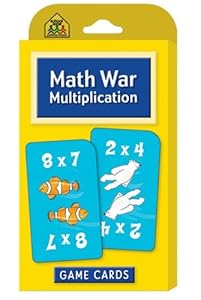
I have the store bought version of Math War and my students were slightly obsessed with it over the summer. At under $3.00, it's definitely worth the money to pick up a couple of sets for your classroom. My own sets have lasted for at least 2 years.

If you are looking for an even more economical way to play Math War make your own cards! At the end of summer school my students were still crazy about Math War so we set out to create our own war cards. Each student made their own set to take home for the summer. ---------->

Each set required 50-75 index cards depending on the number of facts that needed practice. There favorite part was creating the Wild Cards. Not sure what is so exciting about that, but if it gets them excited for practicing multiplication facts I am all for it!  Hopefully they are practicing as we speak!

I made my own back up set with these fun neon cards I found at the Dollar Tree.


                                                                                                                                       Total cost: $1.00

4. Zap It!  
I found this fun game via pintrest. Here is the original pin.

 It's so simple and I know my kids are going to love it! You only need popsicle sticks  and a jar to make this one. You can find the adorable label at Mrs. Young's Explorers. So cute!


She also has a great explanation of the game on her blog as well. Basically students take turns pulling sticks and reading and answering each multiplication fact. If they get the answer wrong the stick goes back in the jar. If they are correct they keep the stick. But watch out! If a "Zap It!" stick is pulled, all of the sticks must be returned to the jar. 
                                                                                                                                      Total Cost: Free 
(I had all of the supplies!)

5. Multiplication Checkers 
Another pin-inspired game...Here is the original pin. Obviously I modified it to use multiplication facts.


Same rules as regular checkers for this one, except that each time a player makes a move they must read and answer a multiplication problem.

I used a dollar store checkers board. Not gonna lie, it's not that sturdy but I think if I cover it with contact paper it will last through the year. 
Total Cost: $1.00


So there you have it! Five multiplication games/centers for under 5 bucks ($3.99 to be exact!). Now that I have my activities set up, I am planning on making variations of each game. I'll be making division games and maybe finding ways to adapt these games for other math concepts too. Oh the possibilities.....
  
Now that was a long blog post!  I hope that you found something useful here. What do you do to improve math fact fluency in your own classroom???? Please share in a comment below. I am always looking for new ideas! 

Related Posts Plugin for WordPress, Blogger...